Cracks in walls are one of the things that sends buyers and homeowners into a panic. But the truth is, most cracks in a property are completely harmless. The challenge — and this is where a RICS accredited surveyor earns their fee — is identifying the small minority that aren't.
At Hammersmith Surveyors, we assess structural cracks in properties across West London every single week. Here's our guide to what different cracks mean, how serious they might be, and when you need to take action.
Why Properties Crack
All buildings move, slightly, over their lifetime. This is normal. It's caused by seasonal temperature changes, moisture content changes in the ground, and the long-term settlement of foundations. The vast majority of cracking in residential properties is the result of this benign, natural movement — what surveyors call "normal thermal or moisture movement."
The problem arises when movement is:
- Continuing, rather than having occurred in the past and stabilised
- Differential (different parts of the building moving by different amounts)
- Significant enough to affect the structural integrity of the building
- Caused by an underlying problem that will get worse over time
The BRE Classification of Cracks
The Building Research Establishment (BRE) classifies cracks in masonry buildings into six categories:
- Category 0: Up to 0.1mm — hairline cracks, negligible
- Category 1: Up to 1mm — fine cracks, slight, cosmetic only
- Category 2: Up to 5mm — slight damage, easily filled
- Category 3: 5–15mm — moderate damage, some opening of joints
- Category 4: 15–25mm — severe damage, windows and doors distorted
- Category 5: Over 25mm — very severe, major repairs needed
In a Victorian terrace in Hammersmith, it's entirely normal to find Category 0–2 cracking in a range of locations. A good surveyor looks beyond the individual crack to assess its cause, direction, and whether it's active or historic.
Key Indicators of Serious Structural Movement
The following signs suggest a crack may warrant further investigation:
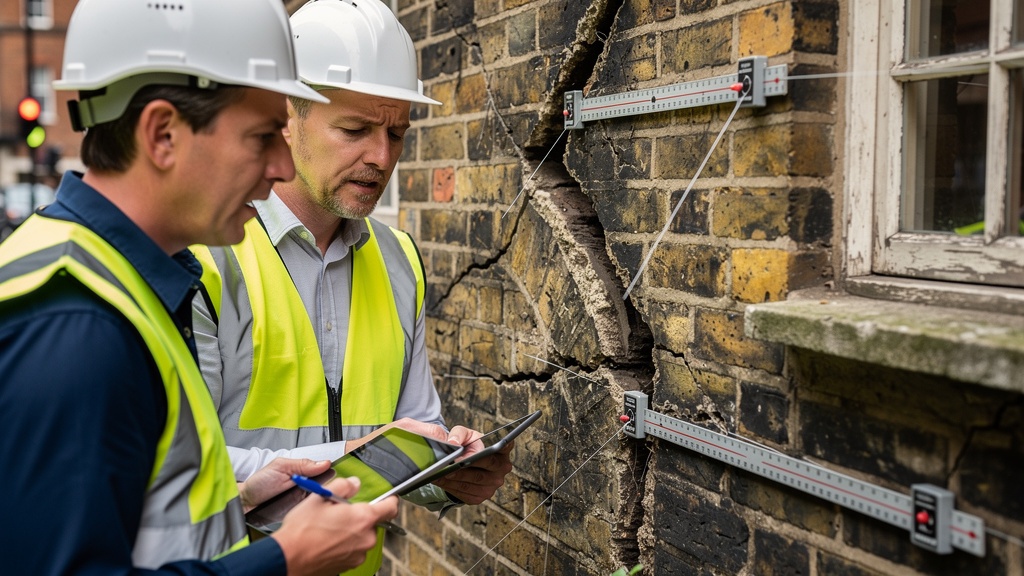
- Diagonal cracking — particularly a staircase pattern through brick mortar joints — is a classic indicator of differential settlement
- Cracking at corners of window and door openings, particularly if accompanied by distortion of frames
- Cracking that is wide at one end and tapers at the other — suggests a point of rotation, often associated with foundation movement
- Cracking that passes through bricks (rather than just through mortar) — indicates more significant force
- Bulging or leaning walls alongside cracking
- Cracking that appears to be active (fresh, clean edges, no weathering, continuing to widen)
Subsidence: What It Is and What Causes It
Subsidence occurs when the ground beneath a building's foundations moves downward, taking the foundations with it. In London, it's most commonly caused by:
- Clay shrinkage in dry summers — London clay shrinks when it dries out, which can cause foundations to sink. This has become more pronounced as hotter, drier summers become more frequent
- Tree roots — large trees near Victorian properties can draw significant moisture from the clay subsoil, causing localised shrinkage
- Leaking drains — water from a cracked drain can gradually wash away ground support beneath foundations
- Previous mining or tunnelling — less common in West London, but relevant in some areas
Case Study: During a Level 3 survey on a 1904 terrace in Ravenscourt Park, we identified Category 4 diagonal cracking in the rear wing. Investigation revealed a mature plane tree within 6 metres of the rear wall, and a leaking clay drain running directly beneath the affected foundations. The buyer renegotiated a £35,000 reduction.
Settlement vs Subsidence: An Important Distinction
Surveyors distinguish between settlement (the gradual, expected compression of soil and building materials after construction, which usually stabilises within 5–10 years of build) and subsidence (ongoing, problematic ground movement). Historic settlement cracks in a Victorian property are usually not a concern — subsidence cracks that are still active absolutely are.
What a Surveyor Does When They Find Significant Cracking
In a thorough Level 3 Building Survey, we:
- Measure and record every significant crack
- Assess the direction, pattern, and likely cause
- Look for evidence of past remediation (crack monitors, resin injections, underpinning)
- Check the property's insurance history for relevant claims
- Advise whether specialist structural engineer investigation is warranted
- If it's a seller's instruction, advise on disclosures required
FAQs on Structural Cracks
Should I walk away from a property with cracks?
Not necessarily. The key question is whether the movement is active and progressive, or historic and stable. With a thorough survey and, where needed, a specialist structural engineer's report, you can usually get a clear picture of the risk — and use it to negotiate an appropriate reduction.
Will cracks affect my insurance?
Significant structural cracking, particularly if linked to subsidence, can affect insurance premiums and availability. It's important to be transparent with your insurer and to check whether the property has a history of subsidence claims before purchasing.
Can subsidence be fixed?
Yes — though it can be expensive. Solutions range from underpinning (from £5,000 per section of wall) to resin injection techniques to tree removal. The right solution depends on the cause and extent of movement.
The Bottom Line
Don't panic at every hairline crack — but don't ignore significant ones either. If you're buying a Victorian or Edwardian property in Hammersmith or West London, a Level 3 Building Survey is the best way to get a clear, professional assessment of any cracking you've noticed.
Contact Hammersmith Surveyors for a free quote today.
Related: Damp in Victorian Homes · Which survey type? · Roof defects