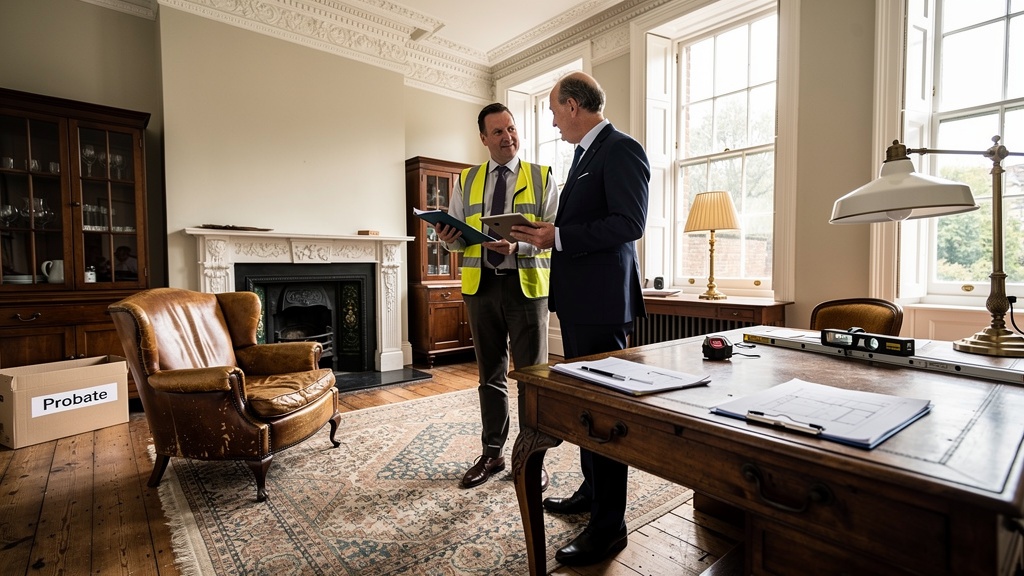
Losing someone close is hard enough without having to navigate complex legal and financial processes at the same time. Yet when someone dies owning property in London — which is very often the most valuable asset in an estate — their executor needs to obtain a formal probate valuation quickly and correctly. At Hammersmith Surveyors, we provide sensitive, professional RICS-standard probate valuations that hold up to HMRC scrutiny. This guide explains the process clearly.
Probate is the legal process of administering a deceased person's estate. When property is involved, a formal valuation is almost always required — both to obtain the Grant of Probate and to assess any inheritance tax (IHT) liability. Getting this valuation right matters, because HMRC can and does challenge figures they believe undervalue an estate.
What Is a Probate Property Valuation?
A probate valuation is an assessment of the open market value of a property at the date of death. "Open market value" is defined as the price that a willing buyer and willing seller would agree, with both parties having full knowledge of the property and acting at arm's length.
This is specifically not the same as an asking price, a quick-sale price, or what a relative thinks the property is worth. It's a professional judgement based on comparable sales evidence from the relevant date, applied to the specific characteristics of the property.
The valuation is required by:
- HMRC, to calculate inheritance tax liability (if applicable)
- The Probate Registry, as part of the Grant of Probate application
- Beneficiaries, to establish a fair base value for CGT purposes if they later sell the property
- Executors, to fulfil their duty to administer the estate fairly and correctly
Why Use a RICS Surveyor for Probate?
HMRC accepts probate valuations from estate agents as well as surveyors. So why pay for a RICS accredited surveyor?
The short answer is protection. A RICS Red Book valuation is prepared in accordance with the internationally recognised RICS Valuation — Global Standards. It includes detailed methodology, comparable evidence, and the surveyor's professional justification for the figure reached. If HMRC challenges the valuation, a RICS Red Book report is far more defensible than an estate agent's informal opinion of value.

For higher-value estates — particularly London properties, where values routinely exceed IHT thresholds — the cost of a RICS valuation (typically £350–£600) is a very small premium compared to the potential consequences of an HMRC challenge on a high-value estate.
What the Valuation Process Involves
Our probate valuation process involves the following steps:
1. Initial Instruction
You contact us with details of the property and the date of death. We confirm our fee and availability, and we'll need to see any property deeds, title documents, or tenancy agreements that exist.
2. Property Inspection
One of our RICS accredited surveyors visits the property to carry out a physical inspection. We assess the size, condition, layout, location and any specific features that would affect value. We take photographs and notes throughout. We approach this with care and sensitivity — we understand that the property may still contain the deceased's belongings and may hold deep personal significance.
3. Market Research and Comparables
We research comparable sales from the date-of-death period — what similar properties in the same area sold for at that time. This is a key element of a RICS-standard valuation and what distinguishes it from a simple opinion of current market value.
4. Formal Written Report
We produce a formal RICS Red Book valuation report, signed by a MRICS or FRICS qualified surveyor, stating the open market value at the date of death. This report is suitable for submission to HMRC and the Probate Registry.
Inheritance Tax and Property Values
In London, where property values are high, inheritance tax is a significant consideration in many estates. Here's a plain-English summary of how it works:
- Nil-rate band: The first £325,000 of an estate is exempt from IHT (the "nil-rate band"). IHT is charged at 40% on everything above this threshold.
- Married couples: Unused nil-rate band can be transferred to a surviving spouse, potentially giving a combined threshold of £650,000.
- Residence Nil Rate Band (RNRB): An additional £175,000 allowance applies if the property passes to direct descendants (children or grandchildren), potentially raising the effective threshold to £1 million for some estates.
- Charitable gifts: Property or assets left to charity are exempt from IHT. Leaving 10% or more of the estate to charity reduces the IHT rate on the remainder to 36%.
The probate valuation figure is central to calculating IHT. This is why HMRC scrutinises probate valuations carefully — particularly for London properties where values are high.
Protecting Against HMRC Challenge
HMRC's Valuation Office Agency (VOA) reviews probate valuations for higher-value estates. If they believe a property has been undervalued — for example, if they can point to comparable sales that suggest a higher value was achievable on the date of death — they will open an enquiry and seek to negotiate the figure upward.
If HMRC successfully challenges an undervaluation, additional IHT becomes due on the increased amount, plus interest from the original IHT payment date. In cases of deliberate undervaluation, penalties can also apply.
A robust RICS Red Book valuation, with clearly documented comparable evidence, is the best protection against this. Our reports are prepared to withstand VOA scrutiny — we document our reasoning clearly and can correspond with HMRC on your behalf if an enquiry is raised.
Selling an Inherited Property
Many executors or beneficiaries ultimately decide to sell an inherited property, either to settle IHT liabilities or to distribute the estate. Our probate valuation can serve as the starting point for the sale price discussion.
We can also advise on:
- Whether the property should be sold as-is or whether modest improvements (clearing, decorating) would improve the achievable price
- The condition of the property — if there are significant structural issues, a quick sale at a realistic price may be more practical than spending money on repairs
- The timing of the sale relative to the probate process
If a full building survey is needed before sale (for example, if the property has been long-tenanted or unoccupied), we can carry this out at a discounted combined rate alongside the probate valuation.
Key Takeaways
- A probate valuation assesses open market value at the date of death — not the current value.
- RICS Red Book valuations are more defensible to HMRC challenge than estate agent opinions of value.
- For London properties above IHT thresholds, a professional RICS valuation is strongly recommended.
- The cost of a RICS valuation (£350–£600) is tiny compared to the IHT exposure on a typical London property.
- The probate valuation also establishes your CGT base cost if you later sell the inherited property.
- Executors have a legal duty to report the correct asset value — professional valuation protects you personally.
Frequently Asked Questions
HMRC accepts valuations from estate agents as well as surveyors. However, if the estate is potentially subject to inheritance tax or if there is any likelihood of dispute, a RICS Red Book valuation from a professional surveyor is strongly recommended. RICS valuations are more defensible to HMRC challenge and are prepared to a strict professional standard.
The valuation date for probate purposes is the date of death. The surveyor must assess the open market value of the property as it was on that specific date, taking into account comparable sales evidence from that time. This is a retrospective exercise if the surveyor is instructed weeks or months after the death.
For a standard residential property in West London, a RICS probate valuation typically takes 5–10 working days from initial inspection to delivery of the formal report. More complex properties may take longer. We understand the time pressures executors often face and always aim to turn reports around as quickly as possible.
The standard IHT nil-rate band is £325,000. For married couples, a transferred nil-rate band can bring this to £650,000. An additional Residence Nil Rate Band (RNRB) of up to £175,000 may apply if the property passes to direct descendants. Above these thresholds, IHT is charged at 40%. The probate valuation directly affects IHT liability.
Yes. HMRC's Valuation Office Agency reviews probate valuations, particularly for higher-value estates. If they believe the property has been undervalued, they can raise an enquiry. A RICS Red Book valuation with robust comparable evidence is the best protection. If HMRC successfully challenges an undervaluation, additional IHT will be due plus interest and potentially penalties.
We're Here to Help — Sensitively and Professionally
Probate can be an emotionally and administratively challenging process. At Hammersmith Surveyors, we carry out RICS probate valuations across West London with sensitivity and professionalism. We work at your pace, communicate clearly, and produce reports that do the job — correctly, first time.
If you need a probate valuation for a property in Hammersmith, Fulham, Chiswick, Kensington or surrounding areas, contact our team. We offer a free, no-obligation consultation to discuss your situation.